
4 hours → 20 minutes
A brief goes in. A branded, on-message first draft comes out, with your pricing and your terms already in it. Your best person only has to review it.
Odokai gives your team AI colleagues. They join your conversations, use your tools, work while you're away and ask before anything leaves. Not another chat window: a team that gets the work done.
From £500 a month (ex VAT) for the whole team, a fraction of the cost of one hire.
One team. Four people, four agents.
 Sofia Managing Director
 James Finance Director
 Marcus Property Manager
 Hannah Brand Designer
Odokai is built by the founders of a software company that went on to list on the London Stock Exchange, with twenty-five years leading engineering teams for M&S, Barclays and Fidelity. About the company
Harbourline runs hotels on the coast. Here is the week its agents started. Every frame is Odokai itself, recorded from the product.
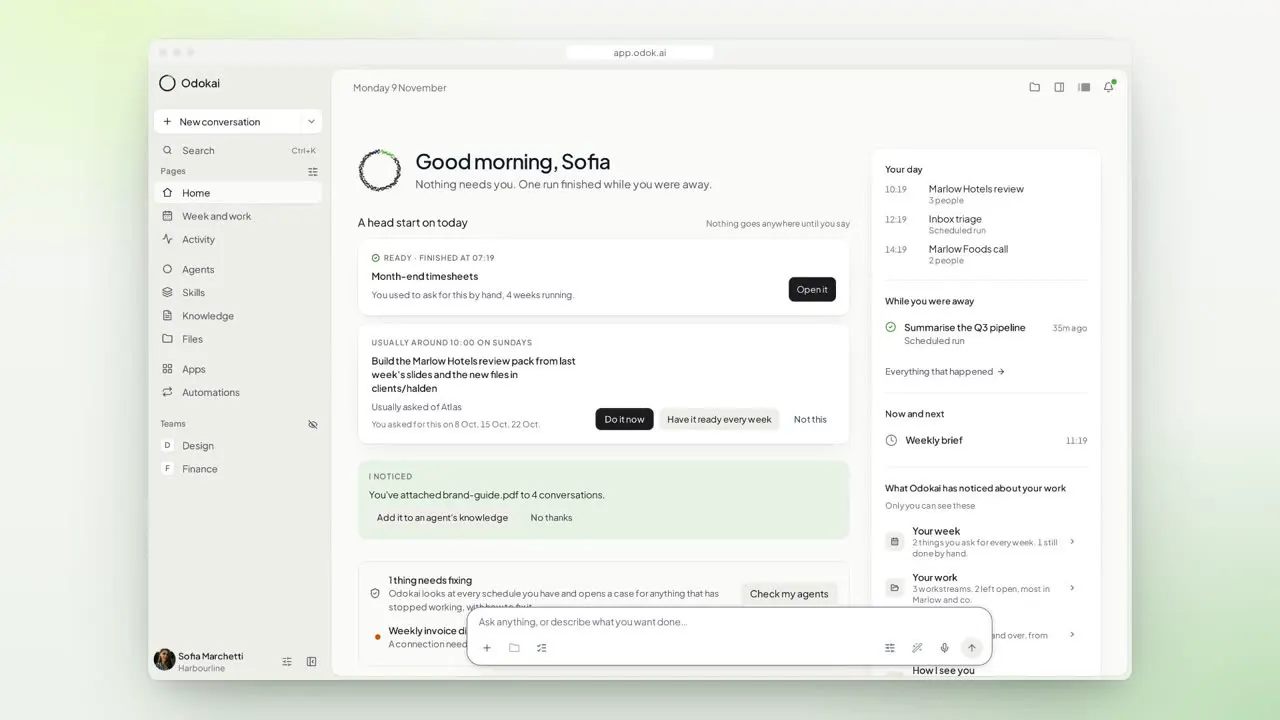
Overnight, the agents worked through the jobs that usually start the week. Home shows Sofia what's done, what needs her and what's next, before her first coffee.
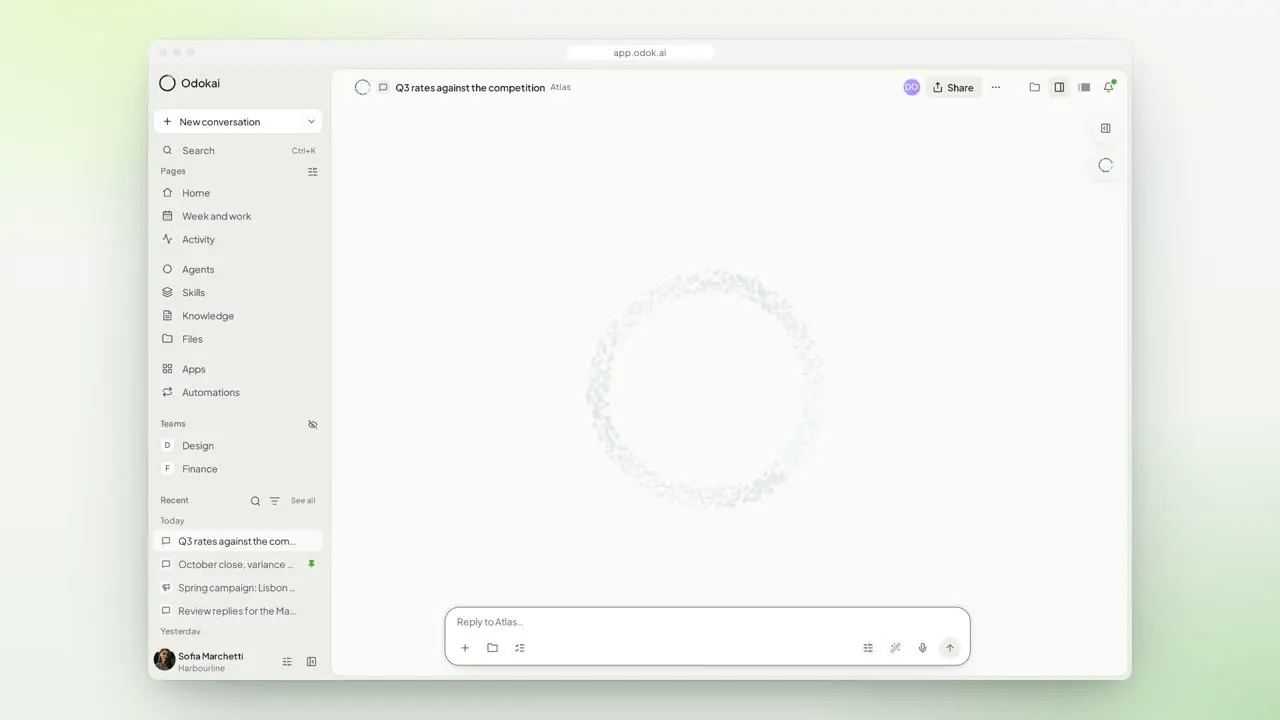
Sofia asks Atlas how her rates compare with the competition. Atlas searches the market, reads her own figures and runs the numbers, then comes back with a recommendation she can act on.
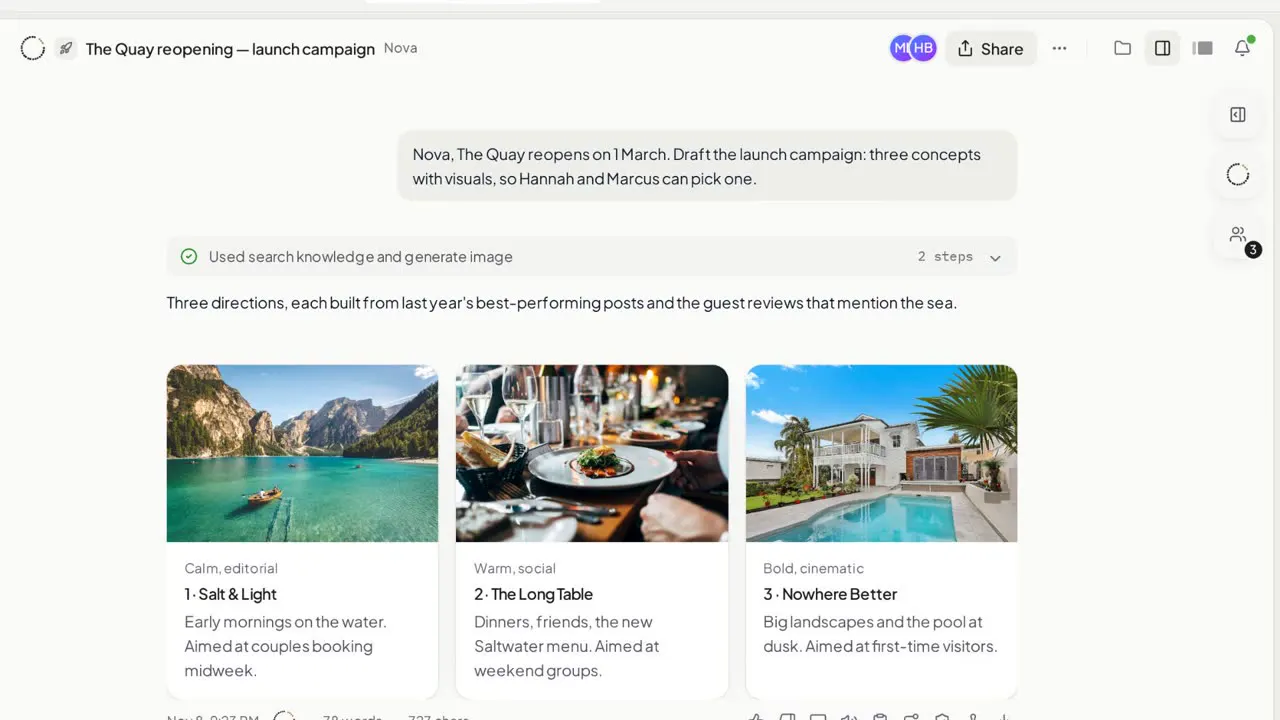
Agents work in the same conversations as your people. Marcus asks, Hannah adds the photographs, Nova does the work, and anyone Sofia invites sees the whole story.
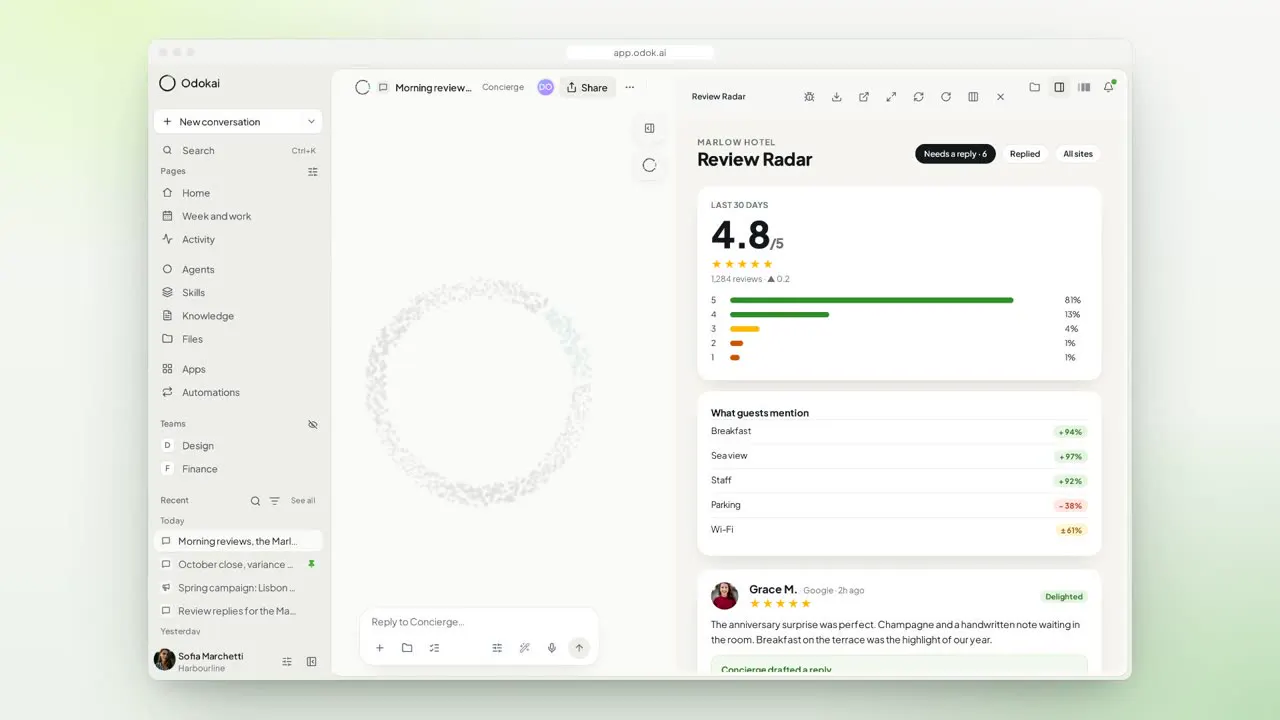
Concierge works through the morning's reviews inside Review Radar, open beside the conversation. Every reply is drafted in Harbourline's voice and waits for a person to post it.
Sofia describes the dashboard she wishes she had. An agent builds it on her own data, checks it, and teaches every other agent on the team how to use it.
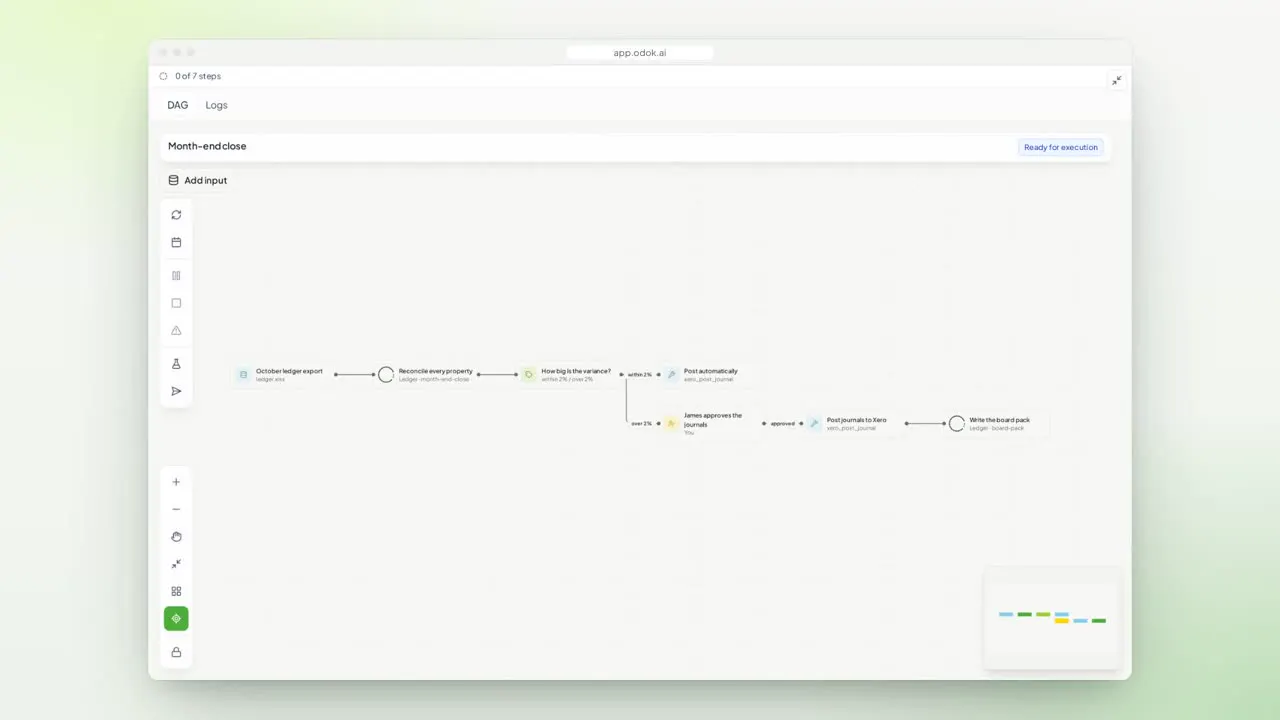
Month-end close runs on its own until it reaches a decision that belongs to a person. It waits, Sofia approves, it finishes. Every step is on the record.
Ask in your own words, and Odokai’s own agent answers.
That's the difference between using AI and having it on your team.
Drafting, first-pass checks, reports and creative work, done on your own data and reviewed by your team. See ten jobs in detail.
4 hours → 20 minutes
A brief goes in. A branded, on-message first draft comes out, with your pricing and your terms already in it. Your best person only has to review it.
Half a day → 15 minutes
Numbers pulled from every system, formatted, and checked against last month before anyone opens it. Someone reads it, signs it, sends it.
All morning → Minutes
First-pass review flags the risk clauses, pulls the key dates and figures, and lists what is missing. A person reviews the flags.
Two days → One hour
A sourced, structured answer to the question you actually asked, with the citations attached. A person reviews it and decides.
Two weeks → An afternoon
Write the brief and get back a built page: copy, imagery, layout, all on brand. Your team reviews it and hits publish.
Days of back-and-forth → The same meeting
Product shots, social tiles, banners, one-off artwork, generated to your brand guidelines. Pick the winners before the meeting ends, then post them.
One login, every leading model, full audit trail. The shadow AI already happening in your team moves somewhere you can see it.
Load in your contracts, policies, and SOPs. Anyone can ask a question and get a cited answer in seconds, without interrupting someone senior.
Build a client portal, a compliance tracker, or a CRM inside the platform, on your own data, and stop renewing the subscription it replaces.
Charts, approvals, agent rules, workflows and share analytics are included. Each answer keeps a record of how it was produced.
Replies arrive as headline numbers, charts and tables, drawn from your own data.

An agent builds trackers, portals and dashboards beside the conversation, on your own data.

Each agent shows what it does alone, what it asks you first and what it never does.

Discounts, tenders and payments wait for a person, with the context to decide.

Share a report, an app or an agent and see how often it is opened. No cookies, no tracker.

Over 600 connectors, including these. Agents read and write through them with the permissions you set. See all connectors
Documents, the search index, the audit trail and workflow logic stay inside your environment. Each model call can be set up as zero-retention, no-training and in-region.
Steps that only sort, label or check go to small classifiers rather than a large model, so less of your text is sent anywhere at all.
We can also set this up so you hold the contract with the model provider directly.
Start on the shared platform. Move to a dedicated instance when you need one, run by us or by your team, in our AWS account or yours. Everything you’ve built moves with it, and agents use only the models you approve.
Shared, dedicated in a cloud account we manage, or your own instance in your cloud account. Your documents, index, audit trail and workflow logic stay inside it.
Every field traced back to the document it came from, every validation recorded, every agent step reproducible. When a regulator, a client, or your own risk committee asks how a figure was reached, you answer from the record.
Odokai is in use in regulated environments, where outputs go to external parties and are checked against compliance frameworks.
1 team
all sharing knowledge, no shadow AI
2+ hrs
saved on each case handled
100%
of outputs carry a provenance trail
Frameworks and harnesses are what developers use to build agents. Odokai is a governed workplace, already in use for regulated work, on your models, with the audit trail attached.
Each agent runs on the model that suits its job, from the providers you choose, and classifiers handle sorting and checking. The table shows what one million tokens costs on three common jobs.
| Example job | Tokens in / out | Top model for every step | Odokai, model matched to each step | Saving on model usage |
|---|---|---|---|---|
| Coding: reviewing and fixing codeSoftware and IT teams | 700k / 300k | $22.00 | $8.8430% top tier, 50% mid, 20% fast | 60% |
| Admin: inbox triage, invoices and updatesOperations and office teams | 800k / 200k | $18.00 | $0.8680% fast tier, 20% mid | 95% |
| Compliance: checking documents against policyLegal, financial services, insurance | 900k / 100k | $14.00 | $2.3260% fast tier, 30% mid, 10% top | 83% |
Illustrative, and model usage only: platform fees are separate. Providers' published standard API prices per million tokens, in US dollars, before caching or batch discounts, checked 20 October 2026: top tier $10 in / $50 out, mid tier $2 / $10, fast tier $0.10 / $0.50. Anthropic and OpenAI list their current three tiers at these prices; Anthropic's fast tier costs more on prompts over 100,000 tokens. Classifier steps are left out of the table. The model mix is set per workflow. On our cloud, model usage is part of your platform fee up to a fair-use volume; in your own AWS account you use your own model accounts.
Bring one job and a few of your own documents. In about 45 minutes we build an agent that does it, so you can judge whether it is worth automating. The call is free.
Free ~45 minutes
Bring a handful of your own documents. On the call, we build an agent that handles one of your workflows, live, on your data. You leave with a working agent and a clear picture of what production-ready looks like for the rest.
Fixed fee 1–5 weeks
We take the agent you saw on the call and make it something you can put in front of clients: edge cases handled, plugged into your systems, every action logged, access controlled, your team trained on it. You sign off the acceptance criteria before we start and the fixed fee doesn't move after that. This is the only workflow that carries a full build fee. Once it's live, the platform and the governance underneath it are set up for good.
Scoped and quoted after the discovery call, once we both know what the workflow needs.
Monthly fee shared or dedicated
What it costs to keep everything running once you're live. Model usage is included up to a fair-use volume we agree during your diagnostic, with a plain stated rate above it. Model upgrades reach your instance at no extra build cost. Your team builds new agents here without paying another rollout fee.
Tell us where to reach you. We'll set up 45 minutes where you watch agents do your kind of work, on documents like yours, and see where they'd fit on your team.
Want to look around first? Watch their first week, browse the platform or ask How can AI help my business?